

What Is a Marketing Funnel and Why It Matters
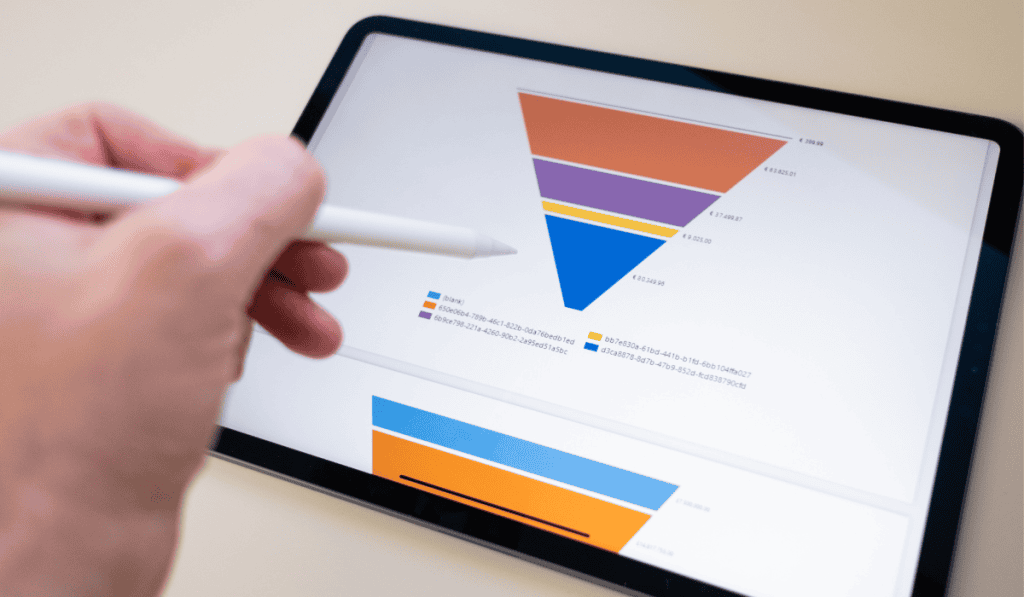
A marketing funnel is a structured representation of the customer journey from first exposure to a brand through purchase and beyond. It helps us map touchpoints, design content, and assign conversion goals at each stage. Calling it a funnel emphasizes flow and attrition: not everyone who becomes aware will convert, so we design upstream and downstream tactics to maximize value at each step.
Why it matters
- Predictability: A clear funnel reduces guesswork. We can estimate leads, conversions, and revenue based on stage-specific conversion rates.
- Alignment: Teams across marketing, sales, and product use the funnel as a shared language. That alignment reduces friction and speeds up testing.
- Optimization: When we break the journey into stages, we can run focused experiments, measure stage-level performance, and prioritize improvements with the highest ROI.
Common misconceptions
Some people treat a funnel as a one-size-fits-all template. It is not. Funnels should reflect buyer complexity, sales cycle length, and business model. A consumer ecommerce funnel is shorter and more transactional than an enterprise B2B funnel. Our goal is to adapt the template to match behavior and realistic timelines.
How to use this guide
We’ll present a practical marketing funnel template you can carry out step-by-step. For teams that want a quick start, the template sections can be populated and rolled out in weeks. For complex organizations, they become the basis for cross-functional roadmaps and detailed playbooks.
Core Stages of a High-Converting Funnel
Successful funnels share the same core stages. Each stage has distinct goals, channels, and metrics. Below we break these stages down so we can design targeted tactics and measure progress clearly.
Awareness, Goals, Channels, and Metrics
Goals: Build recognition, attract qualified prospects, and expand reach. At this stage we want people to discover our brand and understand the problem we solve.
Channels: Paid search, social ads, organic search, content marketing, PR, influencer partnerships, and display advertising.
Metrics: Impressions, reach, website sessions, click-through rate, cost per thousand impressions, cost per click, and new users. Qualitative metrics like brand lift surveys are also useful when we run large campaigns.
Tactical note: We segment awareness activities by intent. High-intent keyword campaigns are closer to conversion while broad awareness channels are optimized for reach and frequency.
Consideration, Content Types and Engagement Tactics
Goals: Educate prospects, demonstrate credibility, and move interested users closer to a decision. We want prospects to evaluate our solution against alternatives.
Content types: Long-form blog posts, comparison guides, webinars, case studies, product videos, and email newsletters.
Engagement tactics: Retargeting, gated content for lead capture, live demos, and community engagement.
Metrics: Time on page, content downloads, webinar registration and attendance, email open and click rates, and lead qualification rate.
Tactical note: Personalization pays off here. If we can segment leads by industry, size, or pain point, our content converts at higher rates.
Decision, Offers, CTAs, and Conversion Paths
Goals: Convert interested leads into customers. We reduce friction and create compelling reasons to purchase now.
Offers: Free trials, discounts, limited-time bundles, onboarding assistance, and product demos.
CTAs and conversion paths: Clear, action-oriented CTAs: streamlined checkout or demo-request flows: trust signals on pages like reviews and security badges.
Metrics: Conversion rate, cost per acquisition, average order value, demo-to-deal rate, and purchase velocity.
Tactical note: Test microcopy, field counts, and CTA placement. Small usability improvements at this stage often yield large lifts in conversions.
Retention, Onboarding, Nurture, and Upsell
Goals: Keep customers engaged, reduce churn, and increase lifetime value.
Tactics: Onboarding emails, product walkthroughs, customer success outreach, periodic check-ins, loyalty programs, and upsell/cross-sell campaigns.
Metrics: Churn rate, retention rate, repeat purchase rate, CLTV, product adoption metrics, and Net Promoter Score.
Tactical note: Retention is often the most under-invested part of the funnel. We find that modest investments in onboarding and automated nurture sequences pay back quickly.
Step-by-Step Marketing Funnel Template You Can Use

Below is a practical template we can apply to most businesses. Treat each subsection as a worksheet item we complete during planning.
Define Target Audience and Buyer Persona
Start by documenting who we’re targeting. Use data from customer interviews, CRM records, and analytics to define: demographics, job titles, goals, pain points, purchase triggers, and preferred channels.
Template fields:
- Primary persona name and role
- Top 3 business or personal goals
- Top 3 pain points
- Typical buying timeline
- Decision makers and influencers
- Preferred channels and content formats
Why this matters: Accurate personas reduce wasted spend and help us craft messaging that resonates at each stage.
Craft Your Value Proposition and Messaging Map
We create a concise value proposition for each persona and map messages to funnel stages. The messaging map should include primary pain points, one-line value statements, proof points, and CTAs.
Example structure:
- Awareness message: Problem statement and introductory benefit
- Consideration message: Differentiators and social proof
- Decision message: Offer, guarantee, and CTA
Tactical tip: Keep language simple and outcome-focused.
Content Plan for Each Stage (Formats & Cadence)
Create a content calendar aligned to the funnel. For each asset include format, owner, deadline, distribution channel, and KPI.
Sample cadence for a monthly cycle:
- Awareness: 2 blog posts, 4 social posts, 1 guest post
- Consideration: 1 webinar, 2 case studies, 1 guide
- Decision: 2 product pages, 1 promotional email
- Retention: 4 onboarding emails, 1 upsell sequence
Why cadence matters: Consistency sustains pipeline velocity and gives us enough volume to test messaging.
Lead Capture: Landing Pages, Forms, and Incentives
Design landing pages for specific offers. Each page should have a clear headline, single CTA, social proof, benefits, and a short form. Incentives might include ebooks, free tools, or consultations.
Best practices:
- Reduce form fields to the minimum required to qualify leads
- Use progressive profiling for deeper data over time
- Include clear privacy statements and trust signals
Nurture Sequence: Email/SMS Workflow Templates
Create modular nurture sequences we can reuse across campaigns. Typical sequences include a welcome series, education drip, and conversion push.
Example welcome series (email):
- Welcome and quick value (Day 0)
- Product use case and social proof (Day 2)
- Educational content or webinar invite (Day 5)
- Offer or demo CTA (Day 10)
SMS can be used sparingly for time-sensitive messages like trial reminders or event invites. Always follow compliance rules and provide opt-out options.
Conversion Assets: Sales Pages, Demos, and Offers
Build conversion-focused assets that remove friction. Sales pages should highlight benefits, include pricing options, show testimonials, and end in a clear CTA.
Demo scripts and flows: Standardize demo flows so each rep covers value quickly, addresses common objections, and asks for the next step.
Offer design: Create layered offers. A low-commitment option lowers the barrier, while a premium option captures high-value buyers.
Post-Purchase Flow and Loyalty Programs
Map post-purchase touches to reinforce satisfaction. Typical flows include an onboarding welcome, product tips, and periodic value-driven emails.
Loyalty program ideas:
- Points for repeat purchases
- Referral bonuses
- VIP access to new features or exclusive content
Retention-focused KPIs should be embedded into our funnel dashboard so the team treats renewals and upsells as top priorities.
Example Funnel Flows for Common Business Models

Seeing templates applied to real models helps expedite adoption. Below are concise funnel flows for three common business types.
Ecommerce Funnel Example (Traffic to Repeat Buyer)
- Awareness: Social ads and influencers drive traffic to product pages. KPI: CTR and sessions.
- Consideration: Retargeting and user-generated content present product benefits and reviews. KPI: Add-to-cart rate.
- Decision: Discounted first-purchase offer, simplified checkout, and free shipping threshold. KPI: Conversion rate and AOV.
- Retention: Post-purchase email with usage tips, reorder reminders, and loyalty points. KPI: Repeat purchase rate and CLTV.
Tactical note: For ecommerce, one-click upsells and cart recovery emails are high-impact levers.
SaaS Funnel Example (Free Trial to Paid User)
- Awareness: SEO and industry content draw organic traffic. KPI: new users from organic search.
- Consideration: Product comparison pages, case studies, and webinars. KPI: trial sign-up rate.
- Decision: Free trial with email onboarding, in-app tooltips, and targeted offers for power users. KPI: trial-to-paid conversion.
- Retention: Customer success onboarding, in-product milestones, and feature-driven upsells. KPI: churn rate and expansion revenue.
Tactical note: Short, value-driven onboarding sequences during the trial significantly increase conversion.
B2B Service Funnel Example (Lead Gen to Contract)
- Awareness: Thought leadership, LinkedIn ads, and targeted outreach. KPI: MQL volume.
- Consideration: Case studies, white papers, and live consults. KPI: SQL conversion.
- Decision: Proposal, pilot projects, and negotiated pricing. KPI: win rate and sales cycle length.
- Retention: Quarterly business reviews, dedicated success manager, and training. KPI: renewal rate and referral volume.
Tactical note: For B2B, aligning marketing and sales around lead grading and follow-up SLA improves conversion from MQL to SQL.
Metrics, KPIs, and Benchmarks for Each Stage
Tracking the right metrics prevents wasted effort. Below we list stage-specific KPIs and practical guidance for attribution and benchmarking.
Key Stage-Specific Metrics to Track
Awareness:
- Impressions
- Reach
- CPM
- CTR
Consideration:
- Content downloads
- Time on site
- Engagement rate
- Lead quality score
Decision:
- Conversion rate
- Cost per acquisition
- Average order value
- Sales-qualified lead rate
Retention:
- Churn rate
- Customer lifetime value
- Repeat purchase rate
- NPS or CSAT
Attribution, Conversion Rate Calculations, and Benchmarks
Attribution: Use a combination of first-touch, last-touch, and data-driven attribution to understand channel impact. We recommend testing with multi-touch models for campaigns that span many channels.
Conversion rate calculations: Keep definitions consistent. For example, define conversion rate for the consideration stage as leads who request a demo divided by the number of engaged users during the period.
Benchmarks: Benchmarks vary by industry. As a rough guide:
- Awareness CTR for display: 0.1 to 0.5%
- Paid search CTR: 2 to 4% on average
- Landing page conversion rate: 10 to 20% for high-intent offers
- Trial-to-paid conversion for SaaS: 2 to 10% depending on product complexity
- Ecommerce repeat purchase rate: 20 to 30% for healthy brands
Use these as starting points, then build internal benchmarks over time.
Tools and Dashboards for Funnel Reporting
We rely on a combination of analytics and BI tools. Common stacks include Google Analytics or GA4 for web behavior, a CRM (HubSpot, Salesforce) for lead and customer data, and a BI tool (Looker, Tableau, or Power BI) for cross-source dashboards.
Dashboard best practices:
- Track stage-level conversion percentages and absolute counts
- Surface trends and anomaly detection
- Segment by channel, campaign, and persona
Tactical tip: Automate daily or weekly reports for campaign owners so insights drive timely action.
Optimization Tips and A/B Testing Plan
Continuous improvement is how funnels stay effective. We recommend a disciplined testing program with clear priorities and rapid iteration.
Prioritizing Tests and Hypothesis Framework
We prioritize tests that move the biggest bottleneck metrics and have measurable impact. Use this hypothesis format:
If we change X, then Y metric will increase/decrease by Z because of reason A.
Prioritization criteria:
- Potential impact (revenue or conversion lift)
- Ease of implementation
- Confidence level based on supporting data
Common Tests by Stage (Headlines, CTAs, Offers, Timing)
Awareness: Creative variations, audience targeting, landing page headlines.
Consideration: Lead magnet formats, webinar timing, long-form content vs short-form, social proof placement.
Decision: CTA copy, button color and placement, pricing presentation, exit intent offers.
Retention: Onboarding email sequence length, timing of renewal reminders, incentives for re-engagement.
Tactical tip: Always run one primary test per page to isolate effect. Use statistical significance calculators to avoid chasing noise.
Running Experiments, Analyzing Results, and Iterating
Experiment workflow:
- Define hypothesis and success metric
- Determine sample size and duration
- Carry out with consistent tracking
- Analyze results and document learnings
- Roll out winners and plan follow-up tests
We keep a test log that records the hypothesis, result, and next steps so future teams learn from prior work. Small, frequent wins compound into major improvements over time.
Tools and Resources to Build Your Funnel
The right tools reduce manual work and let us scale personalization. Below are categories and recommended capabilities.
Email, Landing Page, and CRM Tools, What to Look For
Email platforms: Look for reliable deliverability, segmentation, personalization tokens, and automation workflows. Examples include Mailchimp for simple setups and Klaviyo for ecommerce-focused automation.
Landing page builders: Choose tools that allow fast iteration, A/B testing, and hostability. Unbounce and Leadpages are popular for marketing teams.
CRM: A CRM should support lead scoring, lifecycle stages, and integration with marketing systems. HubSpot and Salesforce are common choices depending on company size.
Integrations, Automations, and Recommended Stacks
Integrations: Prioritize tools that connect natively to your CRM and analytics. Native integrations reduce technical debt and improve data quality.
Automation examples:
- Triggered emails based on behavior
- Lead score thresholds that notify sales reps
- API-based syncs for custom attribution
Recommended starter stacks:
- Small ecommerce: Shopify + Klaviyo + Google Analytics
- Mid-market SaaS: WordPress + HubSpot + Segment + Looker
- B2B enterprise: Custom site + Salesforce + Marketo + Tableau
Templates, Checklists, and Further Reading
We keep a library of reusable templates: landing page outlines, email nurture sequences, demo scripts, and A/B test plans. Building similar assets speeds execution and maintains consistency.
Further reading:
- Classic conversion optimization texts and current blog resources from industry leaders provide tactical playbooks.
Practical tip: Start with a few core templates and refine them after the first few campaigns. Overbuilding templates before you understand real customer behavior wastes time.
Conclusion
A practical marketing funnel template turns strategy into repeatable execution. We’ve outlined the stages, provided a step-by-step template, shown real-world examples, and covered the metrics and tools you’ll need. The most successful teams treat the funnel as a living system: they measure, test, and iterate. Start by completing the persona and messaging exercises, prioritize the most critical bottleneck in your funnel, and run one high-impact test within the next two weeks. If we keep the process disciplined and data-driven, the funnel becomes a predictable engine for growth.